LUPMIS - GIS User Manual for Land Use Planning
Main menu:
- Home Page
- 0. Rationale
- 1. GIS handling
- 2. GIS data entry
- 2.1 Create new layer
- 2.2 Digitize line
- 2.3 Digitize point
- 2.4 Digitize polygon
- 2.5 Edit existing layer
- 2.6 Delete feature
- 2.7 Split line
- 2.8 Split polygon
- 2.9 Merge lines from different layers
- 2.10 Unite lines
- 2.11 Snap lines
- 2.12 Join polygons
- 2.13 Extend polygon
- 2.14 Insert island
- 2.15 Define unit surrounding islands
- 2.16 Create 'doughnut'
- 2.17 Fill 'doughnut' polygon
- 2.18 Fill polygon with 'holes'
- 2.19 Digitize parcels from sector layout
- 3. GIS operations
- 3.1 Create buffer
- 3.2 Create exclusion zone
- 3.3 Overlay units
- 3.4 Convert line to polygon
- 3.5 Derive statistics (area size, length)
- 3.6 Clip unit according to other unit
- 3.7 Create geographic grid
- 3.8 Move entire vector map
- 3.9 Move or copy individual features on a map
- 3.10 Adjust polygon to line
- 3.11 Convert points to polygon
- 3.12 Define by distance
- 3.13 Create multiple objects
- 3.14 Transfer styles from one layer to another
- 4. Attribute database
- 4.1 Start with database
- 4.2 Import database
- 4.3 Display database information
- 4.4 Enter attribute data
- 4.5 Attribute matrix of multiple layers
- 4.6 Seeds
- 4.7 Repair attribute data
- 4.8 Merge lines with attached database
- 4.9 Transfer attribute data from points to polygons
- 4.10 Copy styles, labels, attributes
- 5. Conversion of data
- 5.1 Points
- 5.1.1 Import list of points from text file
- 5.1.2 Import list of points from Excel file
- 5.1.3 Convert point coordinates between projections
- 5.1.4 Convert point coordinates from Ghana War Office (feet)
- 5.1.5 Convert point coordinates from Ghana Clark 1880 (feet)
- 5.1.6 Track with GPS
- 5.1.7 Download GPS track from Garmin
- 5.1.8 Download GPS track from PDA
- 5.2 Vector maps
- 5.3 Raster maps
- 5.3.1 Import raster map from external source
- 5.3.2 Quality-check raster file
- 5.3.3 Georeference scanned map
- 5.3.4 Re-georeference image
- 5.3.5 Load sector layout map
- 5.3.6 Shift raster map
- 5.3.7 Download Google Earth image
- 5.3.8 Clipping and masking images
- 5.3.9 Enhance georeferenced image
- 5.3.10 Batch-convert raster images
- 5.4 Communication with other GIS programs
- 5.4.1 Import GIS data from SHP format
- 5.4.2 Import GIS data from E00 format
- 5.4.3 Import GIS data from AutoCAD
- 5.4.4 Export LUPMIS data to other programs
- 5.4.5 Export GIS to AutoCAD
- 5.4.6 Change a shape file to GPX
- 5.4.7 Transfer GIS data to other LUPMIS installations
- 5.4.8 Digitize lines in Google Earth
- 5.5 Terrain data
- 5.1 Points
- 6. Presentation
- 7. GIS for land use planning
- 8. LUPMIS Tools
- 9. Databases
- Annexes
- A1. Map Maker setup
- A2. Background to cartography and raster images
- A3. Glosssary
- A4. Troubleshooting
- A5. Styles
- A6. Classification for land use mapping and planning
- A7. GIS utilities
- A8. Map projection parameters
- A9. Maps in pilot areas
- A10.Standards
- A11. LUPMIS distribution CD
- A12. Garmin GPS
- A13. Training
- A14. ArcView
- A15. Population statistics
- A16. Entry and display of survey data
- A17. External exercises
- A18. Programming
- A19. Paper sizes
- A20. Various IT advices
- A21. Site map and references
3.13 Create multiple objects
3. GIS operations
3.13 Create Multiple Objects
Level of expertise required for this Chapter: Advanced; general Map Maker training
You can create many copies of the same objects. For example, you draw a parcel of a defined size and shape and want many ‘copies’ of this parcel next to each other in a housing scheme.
1. Preparation to set the display labels in square meters:
Main menu > File > System set up > Units and scales > Set up window: Unit for area: sq.metres > OK
Main menu > Edit > Live layer options > Live layer label options > Live layer labels window: Display label + Area > OK >
2. Draw the unit as precise as possible.
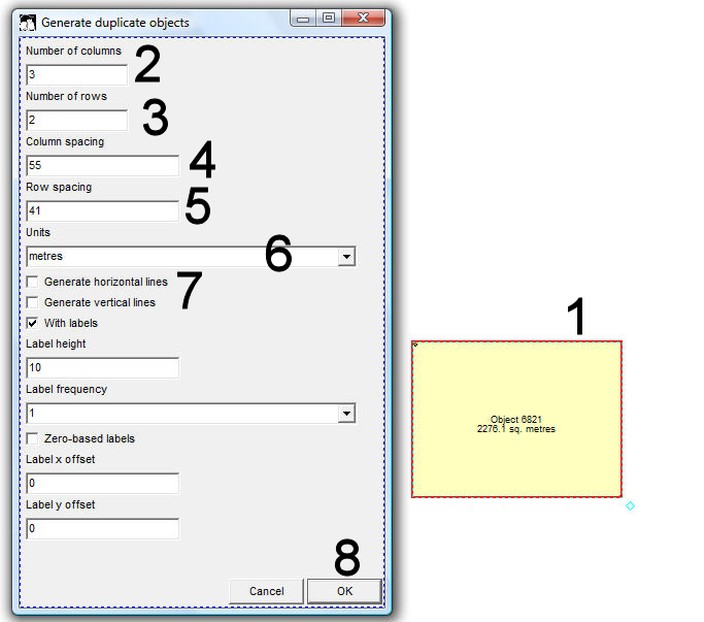
Polygon-tool (at toolbar left) > Draw polygon (1, see below; accordingly, with lines or points) > OK > If you want to adjust the size or shape of the polygon, use the Edit-tool to move the vertex point. With the Tape-tool, measure the width and the height of the object (in meters).
3. After you have defined the parcel, you can make multiple copies in horizontal and/or vertical direction. You can’t copy to other directions, but see step 7 below to handle different directions.
With the Select-tool from the toolbar left, you select the unit(s) to be copied > Main menu > Edit > Show selection manager > Selection Manager window: Actions > Basic operations > Generate duplicate objects > Generate duplicate objects window: Number of columns: Enter the number of copies, you want to have to the right (2) > Number of rows: Enter the number of copies, you want to have above (3) > Column spacing: Enter the meters, you measured under previous step 2 for the width of the object (4) > Row spacing: Enter the meters, you measured under previous step 2 for the height of the object (5) > Units: metres (6) > Leave ‘Generate horizontal lines’ unticked, same with vertical lines (7) > OK (8)
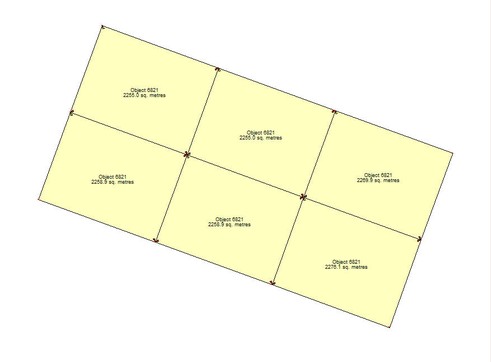
4. You now have multiple copies.

You will have to fine-tune the result:
5. Use the Snap-tool to be sure, that all borders fit to each other.
6. Check, that there are only the selected polygons in your live layer.
Main menu > Edit > Show Selection Manager > Selection Manager window: Find > Find all > Find > If there are any lines, as shown in example below: Delete them

If you want to move or change direction of the entire block, you can do so now.
With the Select-tool from the toolbar left, you select the entire block > Main menu > Edit > Show Selection Manager > Selection Manager window: Actions > Transformations > Use: ‘Shift coordinates of vectors’, if you want to move (shift) the entire block by a given distance (in meters), or use ‘Rotate coordinate of vectors’, if you want to rotate
- - - -
If you have a polygon and want to divide it into 2 equal parts, you can use the external module ‘Half poly’ (supplied by TCPD-HQ / LUPMIS; see step 2.3 of Annex 1.1.1 for installation).
1. Copy the polygon to be divided into a separate DRA file.
2. In Windows Explorer, in folder C:\Map Maker: Double-click on ‘HalfPoly.exe’ > Half polygons window: Choose DRA file > Select file, as created at the previous step > Open > Run > Specify new file name > Save > Close Half polygons window
The polygon is now cut along its longest axis into 2 polygons of the same size. You can continue to split these polygons, to come up with 4, 8, 16... equally-sized polygons.
- - - -
An alternative to draw multiple lines or polygons has been programmed in the Permit Database (outside of standard Map Maker), see Chapter 5.5.


Sub-Menu:
- 3.1 Create buffer
- 3.2 Create exclusion zone
- 3.3 Overlay units
- 3.4 Convert line to polygon
- 3.5 Derive statistics (area size, length)
- 3.6 Clip unit according to other unit
- 3.7 Create geographic grid
- 3.8 Move entire vector map
- 3.9 Move or copy individual features on a map
- 3.10 Adjust polygon to line
- 3.11 Convert points to polygon
- 3.12 Define by distance
- 3.13 Create multiple objects ←
- 3.14 Transfer styles from one layer to another