3. Project Setup
LREPP
A second phase of the 'Land Resource Evaluation and Planning Project (LREPP-II)' was set up and started mid-1993 and was terminated in March 1998.The project was split into four project components, one of these four components is explained in this Paper. This project component was executed by a joint foreign/Indonesian Consultant Association, comprising two international, GTZ (leading firm) and ITC, and two national, MES and LAPI, consulting firms. Funding agency of the loan-funded project was ADB.
The fundamental idea was to have a coordinated approach between four main agencies dealing with land use planning, to develop ‘an overall national programme to strengthen the database, processes, institutions and skills for land resource evaluation and planning.’
The involved Government agencies were:
The main purpose of LREPP-II/B at BPN was the ‘institutional strengthening, assisting BPN in the development of the capability to apply modern methodology and technology to land use mapping and monitoring, while producing the land use maps required for planning and monitoring in the priority areas’.
The following tasks have been completed:
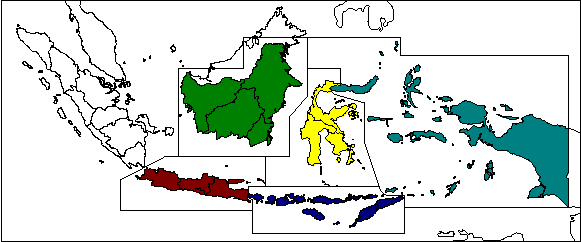
For logistic reasons and for decentralization, the project has been split in five regions, with five regional centers in Jakarta, Samarinda, Denpasar, Ujungpandang and Manado.
Map 1: Regional Setup of LREPP-II/B
By the end of the project some 475 personmonths consultancy services have been given. 11 experts (1 team leader, 1 information system specialist, 1 mapping specialist, 8 land use specialists) have been posted in 5 duty stations (headquarter and 5 regional centers).
Some 125 PC and two workstations have been purchased and installed, with 27 A0 inkjet plotters, 19 A0 pen plotters, 22 color page printers, 45 digitizing tablets, 44 ArcInfo licenses, 29 Erdas licenses.
Selection of software and platform (OS) is a crucial decision before the project execution. Criteria (in the following sequence) are: Do not invest/believe in ‘vapourware’ (software vendors’ promises and beta versions)! Do not expect any GIS software without glitches and bugs! A remark about ‘integrated packages’: While a few vendors offer an integration of raster and vector GIS, they are actually not. At the present, they are an overlay of raster and vector only. |
While ArcInfo is not considered as the most user-friendly and as the ‘state of art’, it is still the GIS market leader with its data format, its abundance of data and expertise worldwide, its strong ability to ‘application development’ with SML, CML, AML languages, and its full functionality. Therefore, it can still be recommended to large organizations for GIS implementations. Similarly, this is true for the DBMS, where dBase is not the ‘state of art’, but has as the first major RDBMS software set the international standards. xBase is still considered as the data format standard. For image processing, installed Erdas 7.5 is now out of the market. Erdas Imagine seems to keep the expectations for an approach as described here (it is presently being installed), as well does Ilwis. |
The described project is a representative example of the second phase of the transfer of an institution to a GIS-operating institution, decentralized and on a relatively ‘low-tech’ level.
GIS implementations (‘diffusions’) have three phases: 1. Initiation phase, to introduce GIS and to build a GIS awareness 2. Implementation phase, to develop the GIS application and to test the system for the later production phase 3. Final institutionalization or production phase, to conduct GIS efforts on a large scale, production oriented, often profit oriented. |
The system as well as the institution is now ready for the third phase, the final 'institutionalization' or the 'production scheme' on a nationwide scheme to conduct digital land use mapping and implementation and monitoring of land use planning.
The final target of BPN is the land use mapping, the issue of location permits based on GIS, the implementation and the control of land use planning and of the issue of location permits all over Indonesia (196 Mio. ha), to be executed at BPN headquarter, in 27 BPN provincial offices and in 394 BPN district offices (in total with some 1400 PC units).
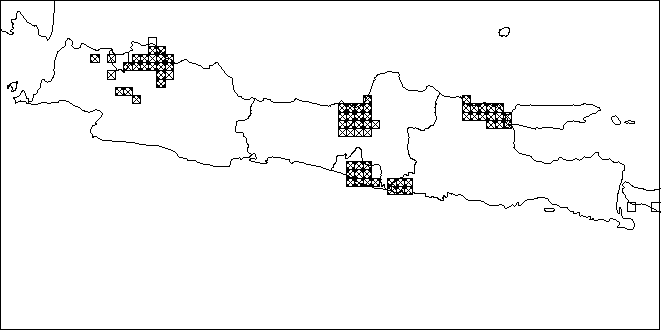
Map 2: Availability of LREPP-II Maps of Land Use
(Sample of Java: Region 1, automatic monitoring retrieval)

 Next chapter